
[Video] Differentiators: The Key to a Unique and Trustworthy Business
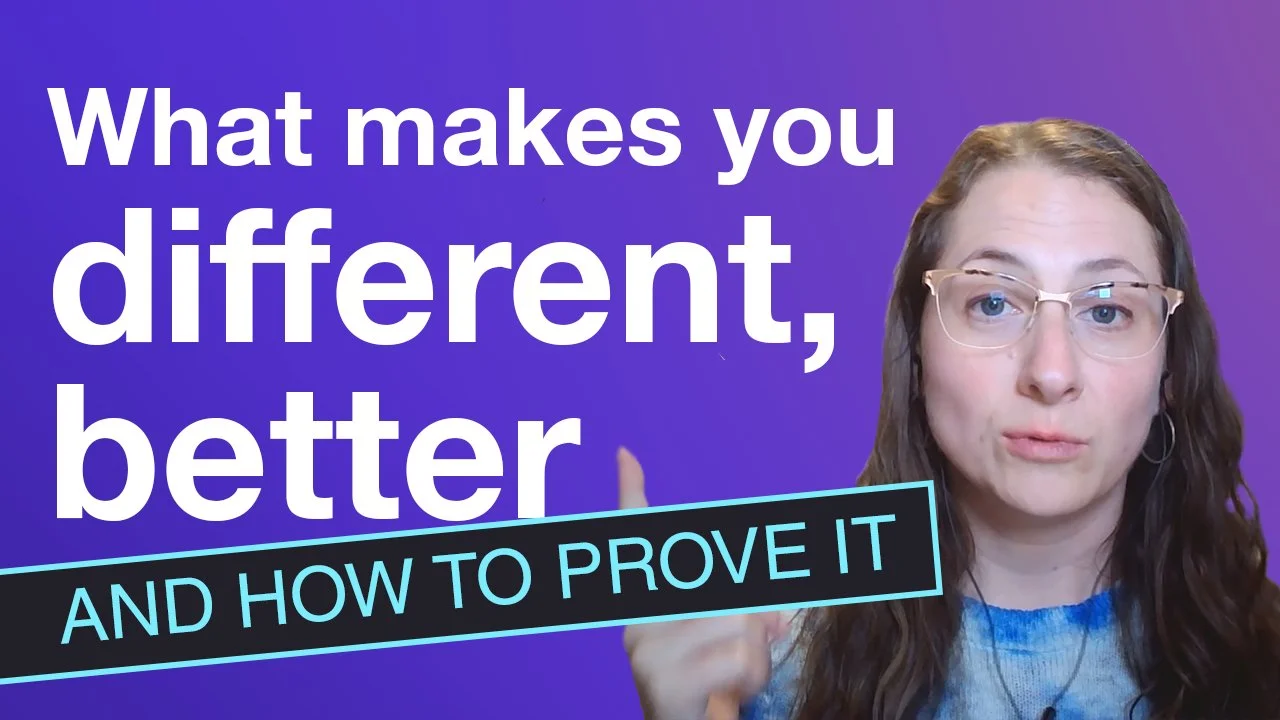
How to Create a Unique Brand and Build Trust with Customers
In this video tutorial, 38th & Kip Owner Alicia Disantis shares an in-depth framework for company differentiators and social proof, which includes real-life examples of reviews, statistics, and case studies in both B2B and B2C marketing. We’ll explore:
What differentiators are
How to find your company's differentiators
How to create trust from buyers by using social proof, like reviews and statistics
Featuring examples from:
Full Transcript
Alicia Disantis: Hi and welcome to the tutorial on differentiators, also known as “why people buy from your company.” My name is Alicia Disantis, founder of 38th and Kip Studio, providing design, branding, and illustration services.
Today we are breaking down how to figure out what makes your company different and why people do business with you. It's one of the most difficult things for businesses to understand. Myself included, it's very challenging to sit down and figure out what makes you different, what makes you better, and how to communicate that to your customers in a way that makes sense for them.
So today we're going to break down the key ways to understand and discover what makes your company different. And also, we're going to discuss how you back up the information of what makes you different with social proof. So it's a powerful way to say, I do this and this and this, and here's why you should buy from me.
But don't just take it from me. So one of the big reasons that it's so difficult to understand what makes you different. And once you understand it, to communicate it, is because we're not really taught how to break down what we do differently as business owners and as companies.
We're been focused so much on explaining why through marketing and selling, and not so much focused on the reasoning behind the why. So example: You would buy from me because I provide exceptional services in A, B, and C. Okay, firstly, is what does exceptional mean to your audience and to your customers? What does better mean? What does higher quality mean? All of these words that as entrepreneurs and business owners you take for granted that your customers are going to understand what that means.
And a big problem that I often see is that assumption that they know what exceptional means or what better value means or however you are positioning yourself to be better than your competition in the the market. So there's zero room for interpretation and zero room for assumption. You need to make it really clear. So let's dive in to how you go about figuring out what actually makes you different and then how to explain it in a way that makes sense.
So there's three key things you need to ask yourself, or even better, get a group of people together or get someone outside of your company and ask. Question one: What do you do better than the competition? So it seems straightforward, but the tricky thing about this question is you first need to know who your competition is, and then really researching and understanding what you do better than them, whether it's through cost, whether it's through a unique skill you have, whether it's the way your business is structured, the location you exist, the way you go about figuring out solutions, the type of solutions you solve. The list goes on and on and on.
So number one, is what do you do better than the competition?
Number two is what does the competition do better than you? And of course, this isn't the most pleasant exercise to go about, but it's important to recognize with us authenticity and honesty where you fall short, because no business is perfect. So understanding what others are doing better than you, and then comparing it to what you do better than others, just these two questions provides a very eye-opening landscape to see where you fall.
Now, the third question that I never see asked, and it's a really important question, is how do you get better at what makes you better? And the reason this question is so important is because it pushes business owners to look into the future and to really understand the motivations behind what they do and what's working. It's the main reason why so much work and effort goes into planning, let's say, an event, but rarely is there ever any retrospective briefing after the event takes place.
Culturally, we're so focused on moving forward and not pausing to understand what's working, what isn't, and why we're even doing this in the first place, that this question is critical to recognize how you get better at your key differentiators and why people buy from you. So now that you've defined, firstly, what you do better than the competition, secondly what the competition does better than you, and thirdly, how do you get better at what sets you apart and what you do better? It's time to back up your claims about why you're better with social proof.
Awards, reviews, publications, statistics, testimonials, and case studies. All six are really powerful examples. But some work better than others depending on your industry and your audience. For example, in the B2B space, case studies perform better. So let's take a look at Drift here, one of my favorite B2B brands. They have such a wonderful and robust case study component to their website that it's really sets the stage for creating a really great environment. So they have a whole section dedicated to this that's on their main navigation that breaks down by the client, by the problem, by the solution. It's really a tremendous example of what you can do if you invest time into case studies.
Reviews can work better if you have more of a packaged goods, more of a certain B2C type of product, where having thousands and thousands of five-star reviews that you can post is very impactful.
So a really great example of using reviews as social proof for your d differentiators is Buffy. And I actually just purchased something from Buffy, so it's been top of mind. They have a really powerful review section. This is an example of one of their most popular products. You can see there's 23,000 reviews, and you can just scroll across over and over and over again and click to your heart's content to read wide variety of different customer experiences with this product.
So when it comes to using publications as social proof, the British band brand Sheep Inc., their sustainable merino wool clothing line has really taken it to the next level. You can see their Instagram is filled with punchy lines from very, very well-known media sources. The perfect sweater from G Crew. BBC talking about how they're leading in the industry of sustainability and supplier ethics. And then you also have the founders talking about what they're doing differently and why they founded this company and their values.
This is a a great way for smaller companies and for new companies to really get out there is to be interviewed by publications and really have more of a back and forth dialogue about what they're doing from a journalism perspective.
Statistics might possibly be my favorite because it's flexible enough that it can work for any industry and really any company. So for statistics, we'll start with the big guys. HubSpot, of course, is a leader in marketing automation and marketing best practices for companies across the globe. Here you can see how they've used statistics to back up their claims as being the best. You can also see here what they've done with using a variety of figures to back up why they're such an incredible solution. Across the board here, there's averages, there's various percentages, totals that reinforce what they do.
Another big name example, this is a very famous advertising campaign from Burger King. And you know, see here, day twenty-eight, they let their whopper sit out to show how it decays to represent how it doesn't have any artificial ingredients.
But then you go over to a smaller brand, made with local, which is a Canadian health foods brand that makes a variety of different bars. You can see what they've done here is they actually say where their ingredients are from, the actual location and city that they source their ingredients from, which is really powerful. They promote their certifications and what makes them sustainable. So they're not just saying we're sustainable as a differentiator.
They're actually proving it with a statistic, or in this case, a certification to back it up. So you can see how statistics can be used in a variety of ways for both very large companies and smaller growing companies. So old saying goes, Numbers don't lie, and they are routinely one of the most compelling.
Features you can have to back up your differentiator statements. Well, testimonials and quotes go hand in hand with case studies, but they're much shorter and they can really act as a very specific pinpoint on a certain benefit you have of your company. So what you can do is you can ask your clients to provide a quote on something very specific, a very specific benefit of what you do. And it can really help craft your marketing message where you take control over what type of social proof you want to have. It's a really great and a really simple way. And if your clients like you, more often than not, they'd be more than happy to give you a quote.
I hope you found this tutorial on differentiators and social proof helpful for your business. Follow 38th and Kip Studio for more tips, how-tos, and tutorials just like this to help understand how to find your company's voice, connect with your audience, and reach your business's goals. Thanks for watching.
![[Video] The Importance of Personal Branding and Style](https://images.squarespace-cdn.com/content/v1/520554d2e4b004c7f36bec69/1763501803563-Z9ETS8FKI0MHAGDHVIQS/personal+branding.jpg)
![[Video] Kindness as a Brand with Rafi Yablonsky](https://images.squarespace-cdn.com/content/v1/520554d2e4b004c7f36bec69/1722997677979-3HT93CR4AMNWKEL2OJYI/BRANDING+S2+E8.jpg)
![[Video] Internal Branding and Company Culture with Aaron Metzger](https://images.squarespace-cdn.com/content/v1/520554d2e4b004c7f36bec69/1703696330734-N87904HVBEU3NR46IRZJ/s2e6+thumb.jpg)